Cross-Contamination: The Hidden Business Risk That Could Cost You More Than Your Reputation
When business owners hear the words cross-contamination, most immediately think of food poisoning in restaurants. But the truth is far broader and far more concerning.
Cross-contamination happens every day in salons, beauty clinics, cafés, restaurants, bakeries, warehouses, healthcare facilities, and retail businesses. It often goes unnoticed because it doesn’t always leave visible signs. Yet, it has the potential to harm customers, expose employees to illness, damage a company’s reputation, and result in costly regulatory action.
The greatest danger is that cross-contamination is often caused by routine tasks carried out without a second thought. A towel used on multiple clients, an improperly disinfected nail tool, a chopping board used for both raw and ready-to-eat food, or an employee failing to wash their hands between tasks can all become pathways for contamination.
The unfortunate reality is that many businesses only recognize the importance of contamination control after a complaint, an inspection, or an incident has already occurred.
A truly safe workplace doesn’t simply react to contamination—it prevents it.
What is Cross-Contamination?
Cross-contamination is the unintentional transfer of harmful microorganisms, allergens, chemicals, or foreign materials from one person, object, surface, or process to another.
This transfer may occur directly or indirectly and can happen in almost any workplace.
Examples include:
- An employee preparing food after handling raw meat without washing their hands.
- A salon reusing equipment that has not been properly disinfected.
- Chemicals being stored beside food products.
- Cleaning cloths being used on multiple surfaces without proper sanitisation.
- Shared equipment transferring bacteria between employees or customers.
Cross-contamination is often invisible. You cannot always see bacteria, viruses, allergens, or chemical residues—but that does not mean they are not present.
Why Every Business Owner Should Care
Cross-contamination is more than a hygiene issue.
It is a health and safety issue, a quality issue, and a business risk.
One preventable contamination incident can result in:
- Customer illness
- Employee exposure
- Product recalls
- Loss of customer confidence
- Negative online reviews
- Regulatory investigations
- Financial losses
- Temporary business closure
- Civil liability
For many small businesses, reputation is everything.
Years of hard work can be damaged by one incident that could have been prevented through proper procedures and employee awareness.
Cross-Contamination Looks Different in Every Industry
Many people believe cross-contamination only affects food businesses.
In reality, every industry has its own contamination risks.
Food Businesses
Food businesses commonly face contamination through:
- Raw and cooked foods being stored together
- Shared chopping boards
- Dirty utensils
- Poor hand hygiene
- Improper food storage
- Inadequate cleaning procedures
These practices significantly increase the risk of foodborne illness and customer complaints.
Salons and Beauty Businesses
Salons experience different, but equally serious risks.
Examples include:
- Reusing towels without proper laundering
- Failing to disinfect scissors, clippers, tweezers or nail equipment
- Double-dipping into creams or waxes
- Using makeup brushes on multiple clients
- Poor hand hygiene between appointments
- Improper disposal of contaminated waste
Customers trust beauty professionals with their health as well as their appearance.
Maintaining strict hygiene standards demonstrates professionalism and builds customer confidence.
Healthcare and Personal Care
Healthcare environments require strict infection prevention practices because vulnerable individuals may be exposed to harmful microorganisms.
Cross-contamination can occur through:
- Medical equipment
- Shared workstations
- Improper glove use
- Poor cleaning procedures
- Inadequate hand hygiene
The consequences can be severe for both patients and healthcare workers.
Offices, Warehouses and Retail
Even workplaces without food preparation or beauty treatments are not immune.
Common examples include:
- Shared keyboards
- Telephones
- Equipment
- Delivery scanners
- Forklift controls
- Break rooms
- Washrooms
- Shared PPE
Illness can spread quickly when cleaning routines are inconsistent.
The Hidden Cost of Poor Hygiene
Many businesses focus on the immediate cost of replacing damaged equipment or repairing property.
Very few calculate the cost of poor hygiene.
Cross-contamination may lead to:
- Staff sickness and absenteeism
- Reduced productivity
- Customer compensation
- Increased insurance costs
- Additional cleaning expenses
- Lost business opportunities
- Damage to your brand
Often, the financial impact of losing customer trust is far greater than the direct cost of an incident.
Common Mistakes Businesses Make
In my experience, cross-contamination is rarely caused by a complete absence of procedures.
More often, it develops because of small shortcuts that become everyday habits.
Examples include:
“The equipment looks clean.”
“I’ll wash my hands after this customer.”
“We’ve always done it this way.”
“It’s only one towel.”
These decisions may seem insignificant in the moment, but collectively they create unnecessary risk.
Safety culture is built or weakened through the small decisions people make every day.
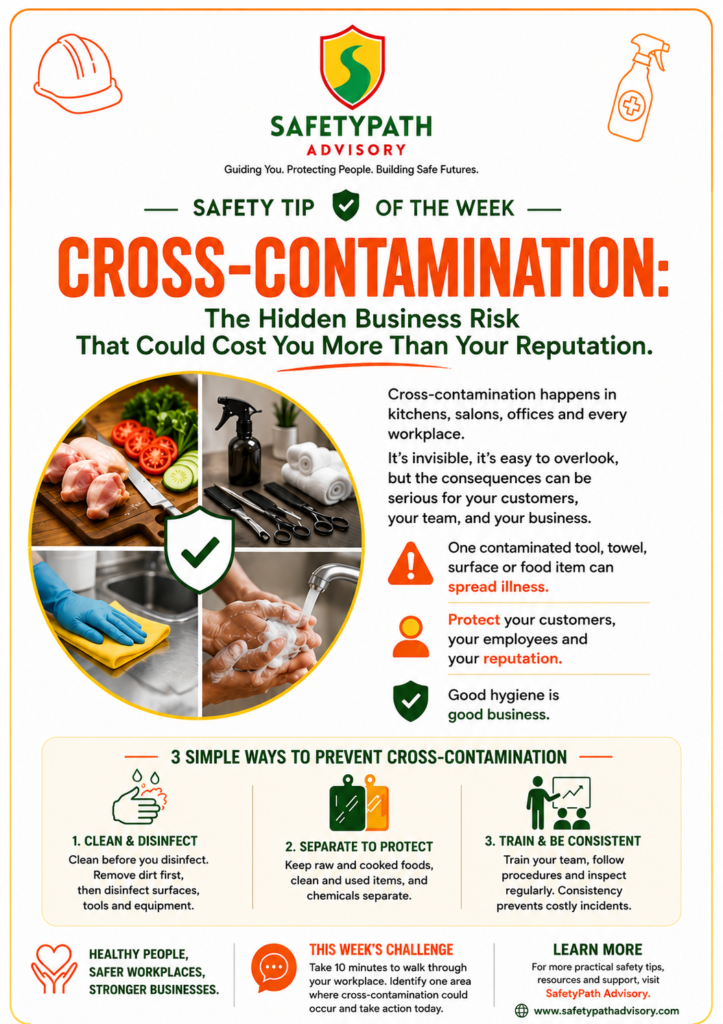
Five Practical Ways to Prevent Cross-Contamination
1. Make Hand Hygiene Non-Negotiable
Employees should understand when and how to clean their hands properly.
Good hand hygiene remains one of the simplest and most effective ways to prevent contamination.
2. Clean Before You Disinfect
Cleaning removes dirt.
Disinfection reduces harmful microorganisms.
Skipping the cleaning stage often makes disinfection less effective.
Both processes are essential.
3. Keep Clean and Contaminated Items Separate
Separate:
- Raw and cooked foods
- Clean and used towels
- Sanitised and unsanitised equipment
- Cleaning chemicals and food
- Clean and dirty storage areas
Simple segregation significantly reduces contamination risks.
4. Train Employees Regularly
Employees cannot follow procedures they have never been taught.
Regular refresher training should include:
- Hygiene expectations
- Cleaning procedures
- Equipment handling
- Safe storage practices
- Reporting concerns immediately
Training should become part of everyday business, not something delivered only after an incident.
5. Inspect Your Workplace
Don’t wait for complaints.
Carry out regular inspections focusing on:
- Cleaning standards
- Equipment condition
- Employee practices
- Chemical storage
- Hygiene facilities
Small observations today can prevent major incidents tomorrow.
This Week’s Safety Challenge
Take ten minutes this week and walk through your workplace with fresh eyes.
Ask yourself:
- Could contamination occur here?
- Are reusable tools cleaned correctly?
- Are employees following proper hygiene practices?
- Are chemicals stored safely?
- Are clean and dirty items separated?
- Would I be comfortable if a regulator or customer observed my workplace today?
The answers to these questions can reveal opportunities for improvement before they become costly problems.
The Bottom Line
Cross-contamination is rarely dramatic.
It doesn’t announce itself with loud alarms or flashing warning lights.
Instead, it quietly develops through overlooked routines, inconsistent cleaning practices, and small shortcuts that gradually become accepted.
Businesses that excel in health and safety understand that prevention is always more effective—and far less expensive—than dealing with the consequences of contamination.
Whether you operate a restaurant, salon, retail business, warehouse, or office, protecting your customers and employees begins with one simple principle:
Clean properly. Separate effectively. Train consistently. Inspect regularly.
Because a safe workplace isn’t just one that looks clean, it’s one where the systems behind the scenes actively protect the people who walk through its doors every day.
About the Author
Adedamola Ojoawo is the Founder of SafetyPath Advisory and a QSHE Director with experience in Quality, Health, Safety, and Environmental Management. She is passionate about helping businesses build safer, smarter workplaces through practical health and safety systems, regulatory compliance, employee training, and proactive risk management. Through SafetyPath Advisory, she supports organisations in strengthening their safety culture while improving operational performance and protecting both people and business success.
About SafetyPath Advisory
SafetyPath Advisory is committed to helping organisations build safer, smarter workplaces through practical guidance, proactive safety strategies, and effective compliance solutions.
We partner with businesses to develop robust health and safety management systems, deliver engaging workplace training, conduct audits and inspections, strengthen compliance, and create safer working environments where people and businesses can thrive.
Because safety isn’t just about compliance—it’s about protecting people, preserving reputations, and building resilient businesses.